

You’re building in the most explosive company-design shift in decades — but most founders are still acting like nothing has changed.
AI reshaped what one person can do, and it’s forcing startups to rethink every assumption about hiring, structure, leadership, and speed. The teams pulling ahead organize themselves differently from day one.
For a century, status and compensation rose with the number of people you managed. In the AI era, it rises with how well you manage AI. That flips the entire design of the company.
Founders often treat structure as fixed. In reality, org design is fluid. It bends to two forces: the technology moment you’re building in and the competitive pressure you face. Right now, that moment is AI. And winning means maximizing three things: your ability to ship, innovate, and create. Anything in your structure that slows you down is poison.
The companies already breaking out have made fundamental shifts in how they organize themselves internally. Here’s what they’re doing differently — and how you can think like them.
Company Form Follows Function
The most successful companies engineer structures that inherently facilitate the culture they require. If you need control and oversight, you should structure your company very differently than if you need speed and creativity.
The origin story of the org chart itself shows the relationship between technology windows, competitive advantage, and organizational structure well.
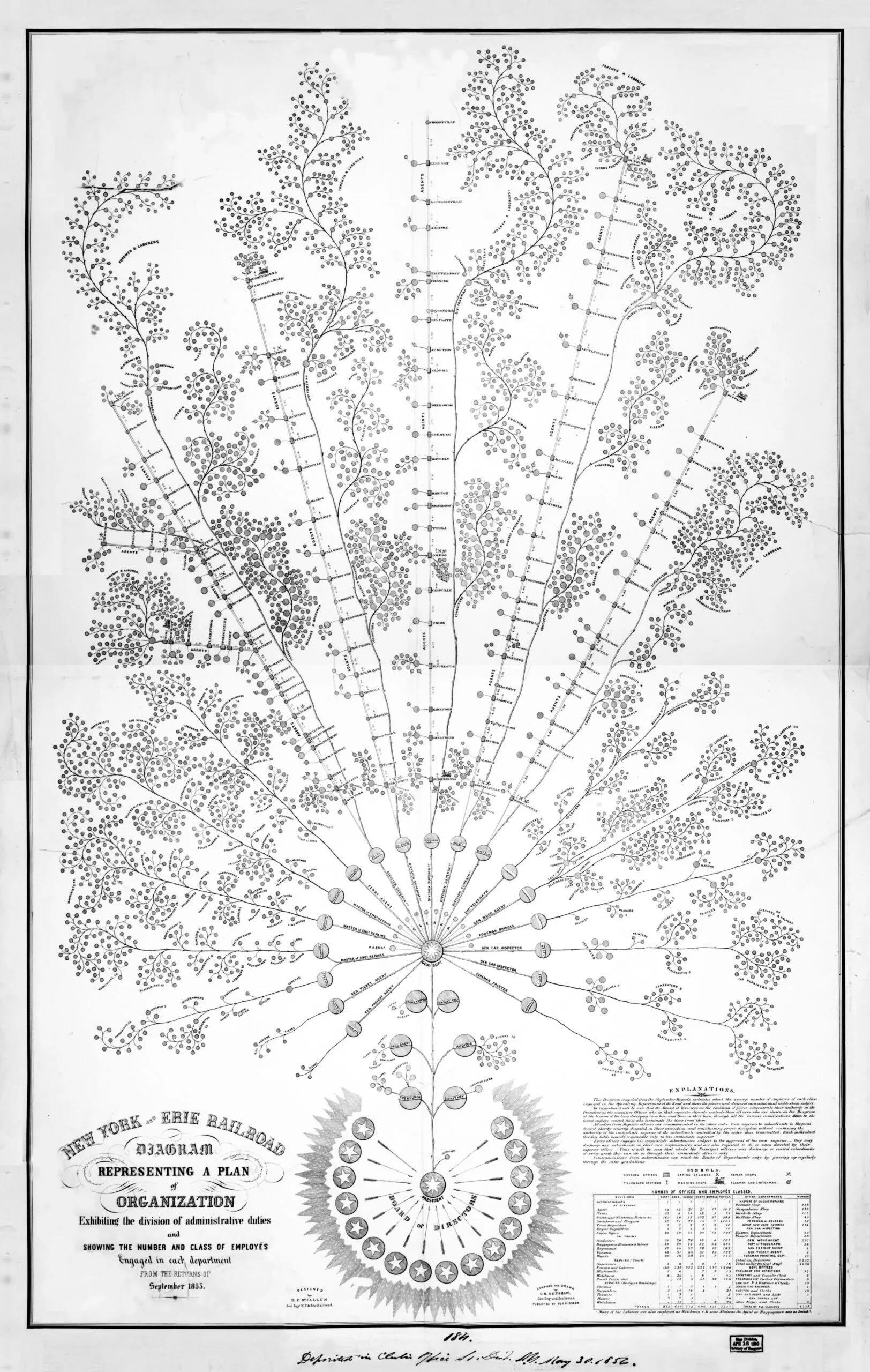
In the 1850s, the New York and Erie Railroad was one of the largest railroad networks in the country, but it teetered on the edge of chaos. As expansion pushed the system past 500 miles of track, the logistical challenge of coordinating trains, and maintaining lines outstripped the company’s ability to manage.
Daniel McCallum, an engineer and eventually the railroad’s general manager, solved the problem. His breakthrough was the first modern organizational chart, completed in 1855.
The chart, designed like a tree, mapped the entire company, showing which lines of responsibility tracked from the board down to the front lines. This structure created a shared sense of command, transparency and control. It allowed him to tame this sprawling network.
The org chart itself isn’t a stunning breakthrough, but it shows how elegant company structure can actually solve massive problems (in this case, issues of life and death).
When it comes to structuring your company, form follows function. The key is realizing what the “function” you need to prioritize actually is.
Often, that core function is related to technology and competition. McCallum knew the railroad game was about efficiency and coordination. That was how you won back in 1855. The company structure was created to prioritize that function – but it came with tradeoffs. Such a strong hierarchy, for example, is slow-moving, and unlikely to innovate quickly.
Your company structure needs to reflect what traits your company needs to win. Here are some examples of technology shifts, and how they affected company structure:
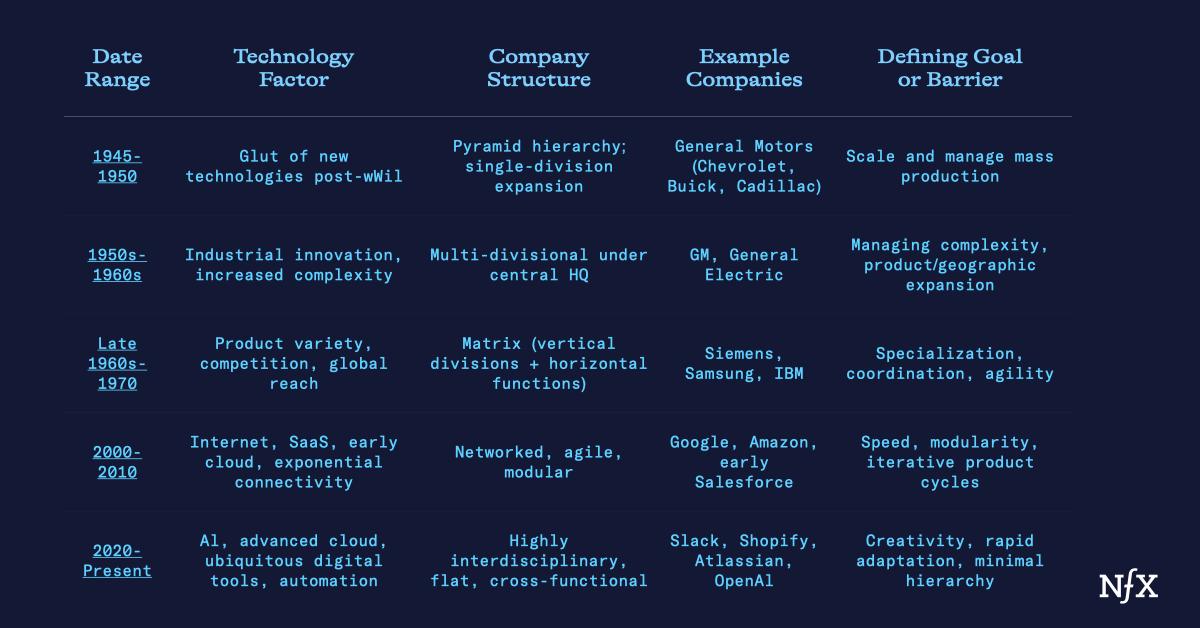
Company Structure in the Pre-AI and Post-AI Era
Today, it’s well established that you win with speed and innovation initially, and with defensibility over time.
The incumbents we reference today reflect that in their company structures: they are intentionally designed for speed.
Amazon pioneered interdisciplinary project teams —“two pizza teams”— capable of moving at startup speed, even at enterprise scale. Atlassian, noticing that the company had begun moving too slowly (even in the pre-AI era) created the concept of “pods” organized by each work stream or project. Each pod is an independent unit consisting of a core member who is primarily focused on that deliverable, part-time specialists who work on many “pods” and leaders who set the agenda.
Today’s major storyline is that AI is “flattening” company structure. But pizza teams and pods tell us that organizations have been flattening for years to prioritize flexibility and speed. AI has simply put this force into overdrive, with three main effects:
- It has completed the flattening, because AI allows more interdisciplinary work at greater speed.
- Because of AI automation, these teams can feasibly be smaller than ever before
- This culture demands a different type of employee psychology – the “entrepreneur within the organization” (we will be writing more about this in coming weeks).
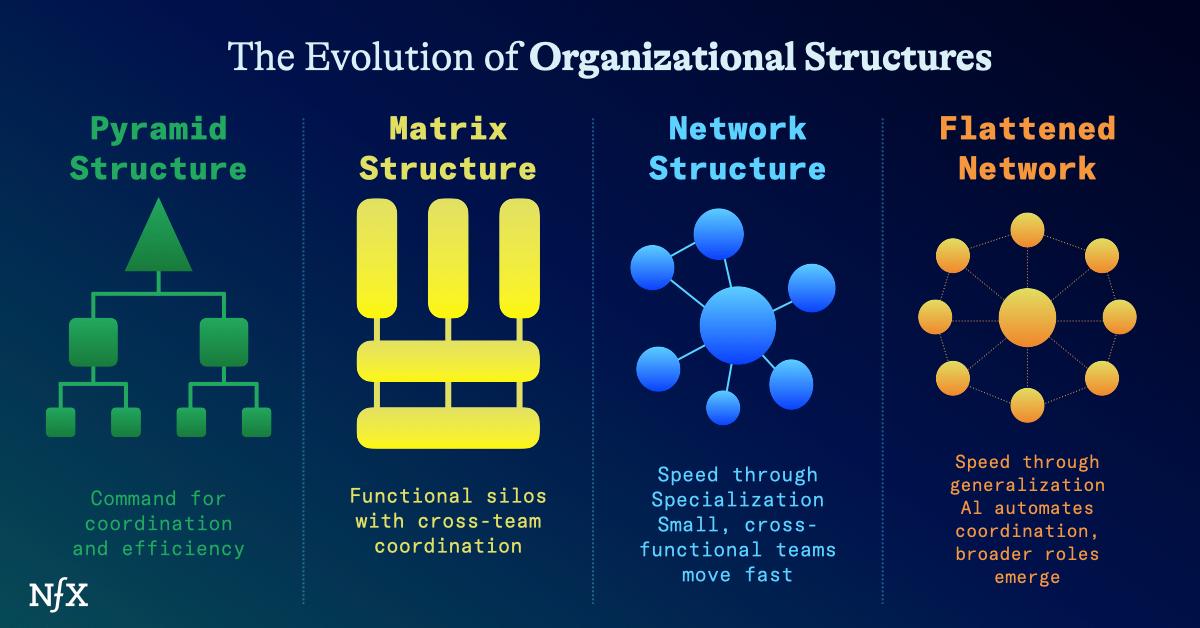
We are consistently seeing startups reach Series A (and beyond) with teams in the low double digits. But what’s far more interesting is the way they are organizing their teams to achieve these milestones.
It starts with your first few hires.
How To Think About Your First Few Hires
AI has fundamentally changed how early teams form. It’s expanded what one person can accomplish, collapsed layers of process work, and shifted the purpose of small teams from coordination to innovation. That means your first hires matter more than ever — not because they’ll “own” a function, but because they’ll help you define how your company works.
There are three questions every founder should answer before they make those first crucial hires:
- What outcomes do you need, and how do you design a role to make them feel inevitable?
AI has flipped the logic of early hiring. Instead of designing roles around processes (“Head of Sales,” “Head of Marketing”), you design roles around outcomes. AI handles the playbooks, and repetitive tasks. What you’re really hiring for is results, taste, and unique insight that allow you to escape early competition.
We’re already starting to see job titles change to reflect outcomes over processes. Roles like “Head of Marketing” are giving way to “Head of Growth.” The old “Head of Sales” might have been responsible for writing outreach playbooks, managing a CRM, and overseeing reps. Today, that person could be a “Head of Outreach” — automating the back-end tasks and focusing entirely on building relationships that close deals.
As a founder, it’s important to see the bigger picture driving this shift in job descriptions: you have more flexibility to design the roles you need, to empower people to achieve your key goals, than ever before.
When individuals can do the work of whole teams, early roles become interdisciplinary and fluid. Your first job descriptions carry enormous weight. They tell people what truly matters and where to direct their time and energy. Broad roles are fine; vague outcomes are not. Paint a picture of impact, not a laundry list of tasks.
- How do you want people to work together – and how should your team design enable that?
When coordination work can be automated, the reason people come together is to innovate: to generate ideas, pressure-test assumptions, and move quickly across product, go-to-market, and operations.
If question 1 was about how you define your role, this question is about how you design an environment that allows the people in those roles to do their best work as a unit.
In an innovation-first environment, you want a team structure that removes friction between functions and empowers people to bring their full skill set anywhere in the company. Early hires shouldn’t be confined to “their lane.” They should be able to jump from writing landing page copy to debugging an onboarding flow to running an outreach experiment — because innovation happens fastest when the same small group can diagnose a problem, propose a solution, and execute it without handoffs.
That’s why early-stage frameworks tend to describe archetypes rather than departments. In “The Three-Person Unicorn,” we talked about teams organized around ways of thinking — numbers, words, founder energy — rather than rigid functional boxes.
High-level by design, they create a shared language for problem-solving. They also make it clear that your job is not to “stay in your function,” but to carry your craft into any part of the business that needs it.
For most teams, this means you need to be in-person. Innovation, creativity, and flexibility happen when people are in the same place, riffing off one another.
Remote setups often work fine at the beginning, when everyone knows what to do. But the second your market shifts or your product matures, you’ll slow down if you’re not together.
There are exceptions — commercializing rare university research, for example. But for most early-stage teams, being together is the secret sauce. Especially with your first hires.
- Who will actually thrive in an AI-first environment?
In the pre-AI era, founders often hired for functional skills. Today, you hire for mindset and taste.
Your early hires need to be comfortable re-inventing how they work regularly. And they need to have strong-opinions (loosely held) about what works and what doesn’t.
One of the clearest signals is a person’s attitude toward AI. A refusal to experiment tells you a lot about psychological flexibility, and the ability to innovate. You need to be optimistic about what’s possible, or you’ll be left behind in this ecosystem.
That said, the mindset you want isn’t blind faith in AI either (there are processes that still need to be improved). What you’re looking for is enthusiastic, informed humility – the ability to recognize that AI is better than most people at most things on most days, and then to redirect their energy toward the parts of the work where humans have the edge: judgment, creativity, relationship-building, taste.
That’s the mindset you want in an AI-first organization.
What Does it Take to Lead an AI-First Team?
As organizations flatten and become more innovation-driven, more emphasis is placed on the founder’s vision. Everyone needs to know the big “why” behind what they do, or motivation suffers, and cohesion falls apart.
Vision has always been important. But how you communicate that vision is taking on different flavors in the post-AI world. It used to be that many founders had a traditional MBA-style charisma. Today, there seems to be several parallel archetypes.
One of them is the “raw” versus refined founder. These founders certainly have vision, and a degree of charisma – important for fundraising. But they don’t particularly care about fitting the mold of “founder.” They are perfectly happy to delegate early, move fast, and build (and fail) publicly.
The delegation piece is especially interesting. Delegation is traditionally quite difficult for founders, even though it’s a natural part of scaling. (we’ve written about it at-length). The new parallel set of AI-enabled founders seems to be more practiced at this. They have been delegating processes to AI agents from Day 1.
(Interestingly, the ability to delegate also seems to be trickling down to the individual contributor level. AI-native engineers often don’t feel the need to know every specific detail of their stack, compared to engineers trained before the AI-era. It’s not that they can’t understand the minutiae, it’s that they don’t spend hours memorizing it in favor of more high-level tasks).
But beyond delegation, these AI-first leaders have developed three distinct skills:
- The best AI-first leaders act as translators between AI capabilities and human judgment. They know when a team member is over-relying on AI output and when another is being overly skeptical.
- AI enables incredibly fast iteration, which can be intoxicating. But not everything is actually strong enough to ship. The ability to create endless first drafts only heightens the importance of knowing what is actually good, high-leverage, and worth putting out into the world.
- AI-first leaders excel at designing the transitions between AI-automated work and human work. They understand both capabilities deeply enough to know where the baton should pass, and they structure work so these handoffs feel natural rather than jarring.
In 1855, McCallum solved coordination.
In 2025, your job is to solve for creativity, and speed.
Everything has changed except for one thing: your company design still has a material impact on your success.