
We’re living in a period of great disruption and reimagination. It’s time for technologists to widen their cultural aperture.
AI has created an inflection point across nearly every industry. The skills that once made people unique are becoming commoditized, and for many, that’s causing a moment of mourning. But this fear only makes sense in a world that rewards predictability and consistency with the past. We no longer live in that world.
While AI will probably have the most profound effect on our society of any technology to date, it’s far from the first time we’ve seen technological disruption. History is a very powerful guide – the issue is that most founders are looking at a very limited set of historical examples.
As execution becomes automated and predictable, conscious thinking shifts toward novel creativity. This makes today’s founders increasingly more like artists than the builders of the last decade. If you study the history of art, music, and writing, one pattern holds: change is almost always expansionary — even when people living through it resist or view it as initially destructive.

Electronic production didn’t end music. Photography didn’t kill painting. Closer to home, superior AI engines didn’t end the game of chess. These fields don’t die; they expand, splinter, and find new directions. The game gets bigger, not smaller. They are infinite.
Yet many founders — and investors — apply finite thinking to technology (“SaaS is dead,” “it’s the end of programmers” and the like). Yes, windows of opportunity open and close. But in the long run, they always multiply.
That’s the mindset we need: infinite, expansionary, oriented toward what becomes possible rather than what gets displaced. Art has always known how to navigate change this way. It’s time for startups to learn the same lesson.
Photography and The Expansionary Arc
To understand what AI will do to technology, it helps to study what the camera did to art.
When Louis Daguerre unveiled the daguerreotype in Paris in 1839, portrait painters were among the first to panic. (Although earlier experimental processes existed, the daguerreotype was the first publicly announced and widely adopted photographic process.)
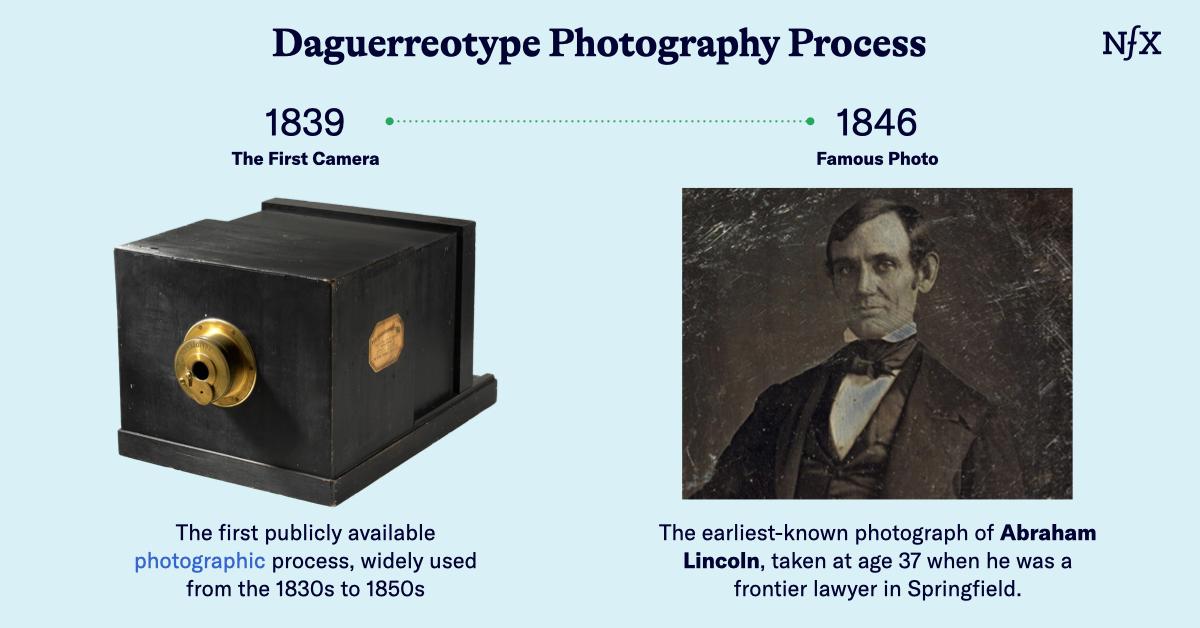
Here was a machine that could capture a human likeness in minutes with perfect fidelity. The craft of portraiture — a primary livelihood for many working artists — seemed suddenly obsolete.
The French painter Paul Delaroche reportedly declared, “From today, painting is dead” (though this fact is widely reported, it is far from confirmed).
However, interestingly, there was yet another, even stronger reaction to the daguerrotype from major societies in the art world. As Samuel F.B Morse — a portrait painter and creator of the telegraph — said in a speech to the National Academy of Design in 1840: “The daguerreotype is undoubtedly destined to produce a great revolution in art, and we as artists should be aware of it and rightly understand its influence.”
Painting was not dead. But something did die: the necessity of painting as pure documentation, as Morse notes. And from that death, an explosion.
Painting simply continued to evolve. Impressionism emerged. Then Expressionism and Cubism. The medium that was supposed to kill painting actually became yet another complementary art form – and the two would continue to influence one another for years to come.

But that’s only half the story. Because photography itself created an enormous opportunity, too. What started as a single invention in the 1830s became, over the following century and a half, a cascade of entirely new industries and methods of expression.
The daguerreotype gave way to the calotype process, which enabled mass printing. Mass printing of photographs had sweeping effects across art, news, and the economy.
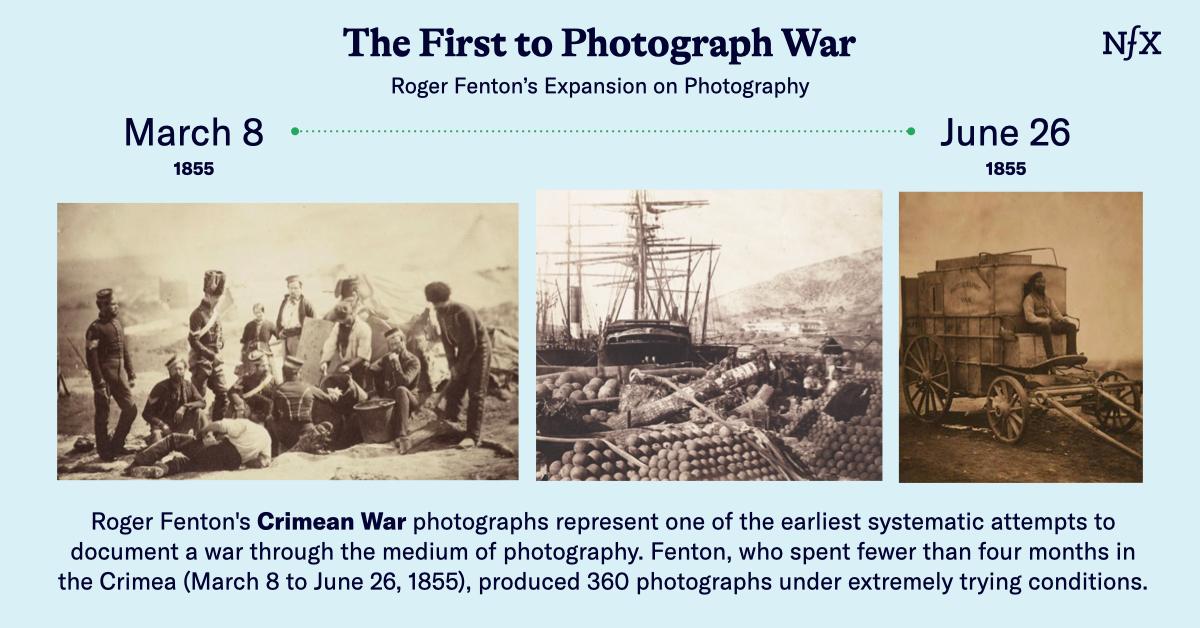
Within a decade, publishers and governments were hiring photographers. Famously, photographer Roger Fenton spent several months on the Crimean front in 1855, in one of the earliest systematic attempts to “document a war” for the home audience. Fenton’s work today represents one of the earliest forms of photojournalism – a new profession, a new form of public record, and eventually, a new form of political power.
But at this point, photography was still an expert’s game. Innovation, again, changed this dynamic and created more opportunities. Around 1900, Eastman Kodak launched the “Brownie” – a simple camera sold for just $1 and initially marketed to children. By 1905, an estimated 10 million Americans had become amateur photographers.
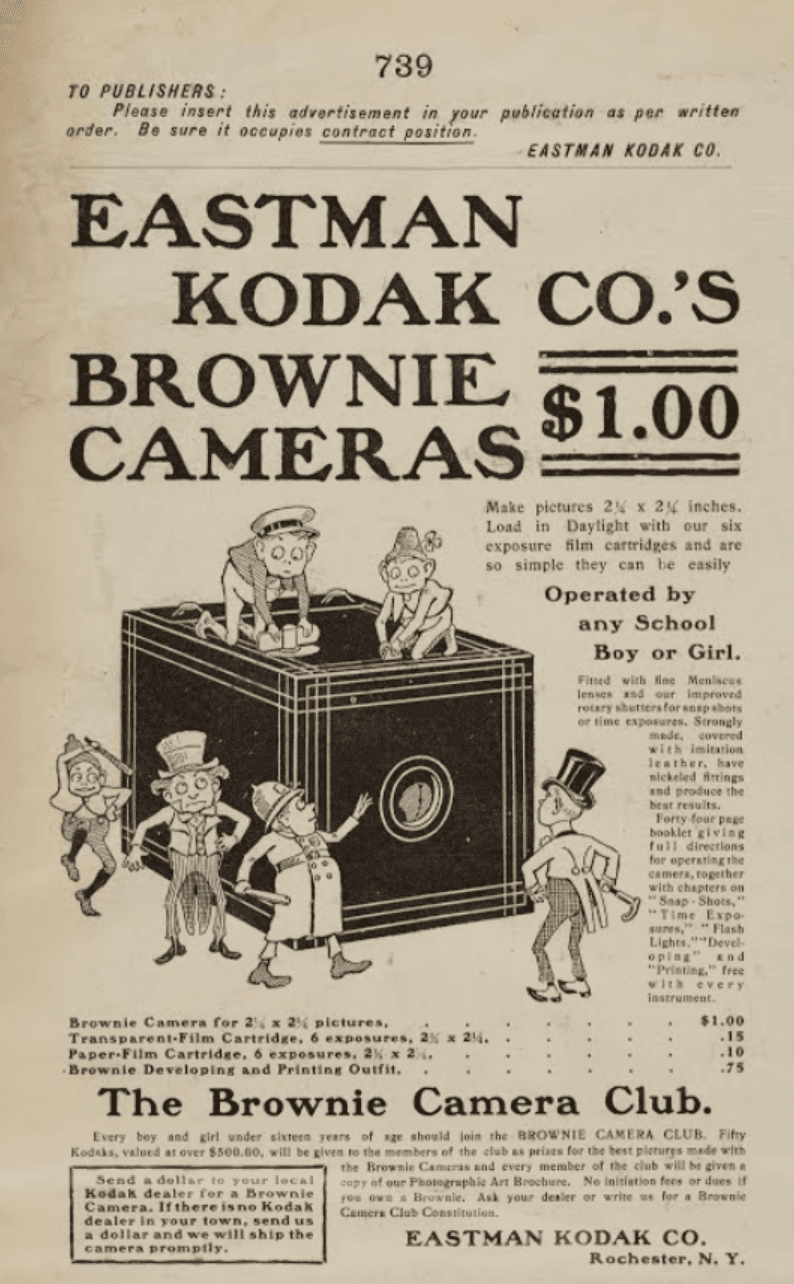
Suddenly, everyday life — picnics, vacations, birthday parties, street scenes — entered the visual record, and personal photo albums joined newspapers and archives as another kind of informal public memory. This effectively created the amateur photography market.
Still, more offshoots would appear within the next few decades. In 1925, the German firm Leitz introduced the Leica I, a compact 35mm camera that could fit in a coat pocket. Its small size made it possible to photograph quickly and unobtrusively in public, helping to catalyze what would become street photography – a critical part of social discourse and public memory.
In the 1940s, Polaroid would pioneer “instant photography” (supposedly because the creator, Edwin Land, was asked by his daughter why she couldn’t instantly see a photo he had taken of her). This prefigured, decades early, the social logic of the smartphone camera.
Each technical leap didn’t replace the previous ecosystem. It is layered on top of it, while simultaneously spawning entirely new ones. Professional studios, darkroom culture, photojournalism agencies, consumer film labs, instant print shops — all of these were industries that emerged in response to the ongoing disruption of photography.
Even the smartphone didn’t end photography. Instead, it turned billions more people into photographers, created entirely new platforms for image distribution, and spawned new aesthetic movements, professions, and economies around visual content.
The field didn’t contract under pressure. It exploded, again and again, in every direction.
This is what people mean when they say AI will create new industries, but rarely illustrate with enough specificity to land. The claim sounds abstract because we’re describing something we can’t yet see.
Photography shows us the mechanism. A genuinely transformative technology changes what’s possible, which changes what people attempt, which creates demand for things that didn’t exist before, which creates the businesses, professions, and markets to meet that demand.
We are, right now, at the daguerreotype moment of AI. The panic is real, and the displacement is painful for many. But if the history of photography teaches us anything, it’s that what looks like an ending is almost always a beginning in disguise — and that the new territory is almost always larger than the one that came before.
Great artists and inventors have always recognized this.
Mastery of Craft → Mastery of Expression
Much of the tension around AI today stems from its rapid devaluation of mastery of craftsmanship. In fields like coding and writing, in particular, nearly every user can produce serviceable, even excellent, output without having done the legwork to become a true expert.
The new valuable trait, as many have observed, is taste. But even this likely won’t last long, given how quickly AI is advancing.
Why? Taste is backward-looking. It evaluates what has worked before and copies it. AI is likely to catch up to this, too. Many companies are working on predicting what humans like and dislike – on codifying, even commoditizing “taste” itself based on the past. What feels like rare human discernment today may simply be a learnable signal tomorrow.
This means expression will replace taste. Expression is forward-looking. It makes a statement about what could be. AI can learn the former; only a human with a genuine point of view can supply the latter.

Art, again, shows us the power of expression over craftsmanship and taste.
Before Picasso dismantled form and began developing Cubism, he was an extraordinarily gifted academic painter. He was a master of realist painting. He painted the first panel below at the age of 15:
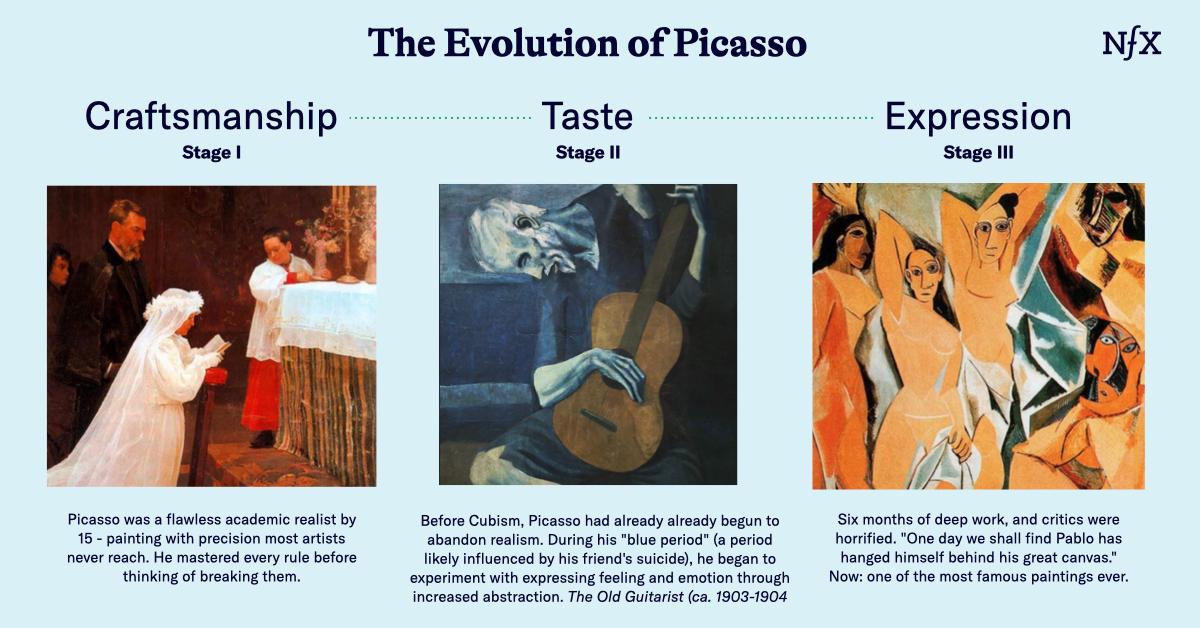
From his realist beginnings, Picasso then began to experiment with expression in fits and starts. Pure realism gave way to works that showcased the artists’ inner worlds alongside their subject matter. The works were still recognizably “real” (this wasn’t Cubism just yet), but this shows how mastery of craft was giving way to artistic taste — choosing certain forms, light, and colors over others to convey a certain mood. (See the second panel, from his “Blue Period.”)
And then, in 1907, he appeared to throw it all away. That year, he debuted his Les Demoiselles d’Avignon to the Paris art scene (the third panel above).
The painting was the result of a 6-month period of deep work. You can imagine: hundreds of preliminary sketches, paintings, and drawings strewn across the floor of the painter’s studio. Picasso was deliberately dissecting images of the human body. He reimagined limbs as angular, flat planes. Almost sculpture-like, and larger than life. He incorporated influences from African, Iberian, and Oceanic masks. He poured his internal world into the depiction of the figures – he later called it a “personal exorcism.”
And the result? Critics hated it. Fellow artists even more so. “One day we shall find Pablo has hanged himself behind his great canvas,” Derain reportedly wrote later.
Today, this is one of the most famous paintings in the world.
When Picasso painted Les Demoiselles d’Avignon in 1907, he wasn’t abandoning skill. He was choosing expression over representation, and in doing so, expanded the field of art, taking it in a whole new direction.
True creative geniuses, like Picasso, are constantly seeking a higher plane of creativity. It is there that they create remarkable, unexpected, and controversial results.
That is the model for the decade ahead. AI will now pay the skill entry fee. It is the ultimate craftsman. In the short term, a class of “critics” trained in the “old way” will act as tastemakers. But in the long run, those seeking the higher plane will win. They will be those who use the commoditization of skill to expand the creative surface. What is newly possible via automation is simply table stakes – it almost becomes uninteresting to them because they are working to make new rules altogether.
They will use the new tools at their disposal to say something original and real.
“Never Play to the Gallery”
There’s a David Bowie quote that translates especially well to this moment. Especially that drive to work toward a “higher plane” of creativity:
“Never play to the gallery. Always remember that the reason you initially started working was that there was something inside yourself that you felt, if you could manifest it in some way, you would understand more about yourself and how you coexist with society…if you feel safe in the area that you’re working in, you’re not working in the right area. Always go a little further into the water than you feel capable of being in.”
This is the posture that the next generation of founders needs to carry into the AI era. Not the defensiveness of the craftsman watching his skills depreciate. Not the caution of the tastemaker protecting what has already been validated. But the artist’s confidence — ready to use the tools and perspective at their disposal to make something new that could only come from their brain. To seek that undefined “higher plane.”
The infinite game of creation never stops. Artists are almost always among the first to realize this. Even today, artists are using AI to create new forms of human expression. For the last few months, at the Museum of Modern Art in New York, poet Sasha Stiles has been exploring the interplay between human and machine writing. She created an alter-ego: Technelegy, an AI that emulates and expands upon her writing. The result is a poem that rewrites itself every 60 minutes.


The daguerreotype moment always looks like a threat from the inside. These are currents of fear, and they will threaten to pull you backward, into the past. Many will succumb to that fear.
But photography didn’t kill painting; it morphed and expanded it. And photography didn’t kill itself either. It just kept growing, pulling new worlds into existence with every technical leap. AI will do the same.
The only pattern that matters today is the infinite re-invention.
Turn your boat upstream.


As Founders ourselves, we respect your time. That’s why we built BriefLink, a new software tool that minimizes the upfront time of getting the VC meeting. Simply tell us about your company in 9 easy questions, and you’ll hear from us if it’s a fit.